


 Free Newsletter

SC justices have serious questions about trial, conviction of Alex Murdaugh
Reuters//February 12, 2026//
SC justices have serious questions about trial, conviction of Alex Murdaugh
Reuters//February 12, 2026//


 Listen to this article
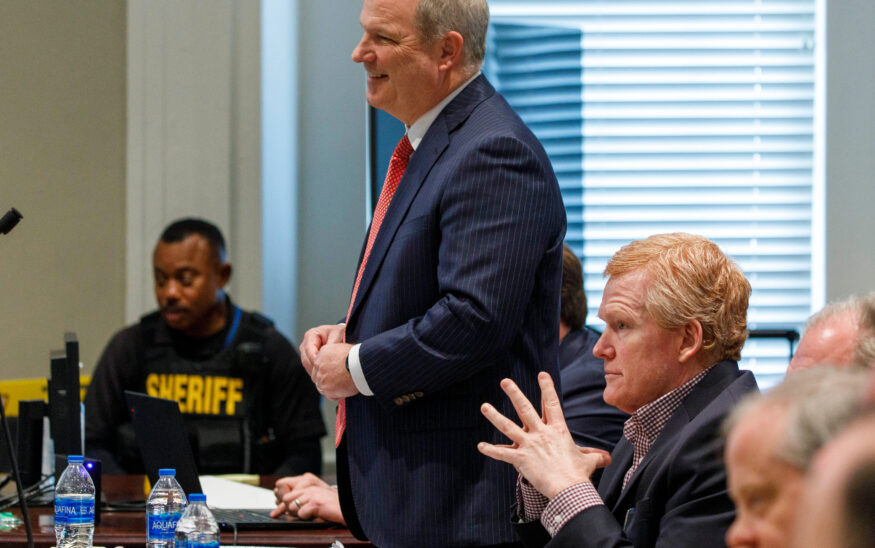
The South Carolina Supreme Court heard oral arguments on Feb. 11 in the double-murder conviction appeal of disgraced former lawyer Richard Alexander “Alex“ Murdaugh, and it was clear that the majority of the high court justices had serious questions about the 2023 trial and conviction of Murdaugh, as well as the ruling from a lower court appeal hearing held in early 2024.
In a session that began at 9:30 a.m. and concluded just after noon in the historic S.C. Supreme Court Building in Columbia, the Supreme Court justices asked pointed questions and made strong statements about several key issues, namely the admission of large amounts of financial crime evidence in a murder trial and alleged jury tampering by a court official.
Murdaugh, a former Hampton attorney also convicted of multiple fraud-related crimes worth millions of dollars, was convicted in March 2023 for the June 2021 murders of his wife, Maggie, and younger son, Paul, before Circuit Judge Clifton Newman in Walterboro.
Following the jury trial conviction, Newman sentenced Murdaugh to two consecutive life sentences, but the disbarred lawyer, who admitted the fraud but denied the killings, almost immediately appealed his case to the Supreme Court over allegations of jury tampering and other legal grounds to be argued before the high court.
The S.C. Supreme Court is currently composed of Chief Justice John W. Kittredge and Justices John Cannon Few, George C. James Jr., D. Garrison Hill, and Letitia H. Verdin, who were all present.
SC Supreme Court hearing starts with questions
Murdaugh had three attorneys presenting his arguments: Richard “Dick” Harpootlian, James “Jim” Griffin, and Phillip D. Barber.
Presenting the state’s case was Senior Assistant Deputy Attorney General Creighton Waters. Attorney General Alan Wilson was seated at the counsel table.
Chief Justice Kittredge informed those attending and viewing the proceedings not to interrupt or disrupt the court, and informed legal counsel that their first five minutes of oral argument would not be interrupted by questions from the justices.
The “Appellant,” or Murdaugh‘s legal team, had 20 minutes to present oral arguments stemming from the appeal of the denial of the motion for a new trial, while the “Respondent,” the State of South Carolina, represented by the S.C. Attorney General’s Office, also had 20 minutes to present counterarguments.
Harpootlian says the right to a fair trial most important amendment
Harpootlian took the first argument for Murdaugh‘s team, opening up with a flashback to 50 years ago, when he took the oath as a new lawyer to uphold the Constitution, adding that the 6th Amendment that protects the right to a fair trial is perhaps the most important amendment, and that the First and Second Amendment “mean nothing without the right to a fair trial and a fair jury… a jury not poisoned by outside influences.”
Harpootlian criticized the actions of former Colleton County Clerk of Court Becky Hill, who is accused of jury tampering, and who published a book that the public later learned was plagiarized, adding that he has never seen a factual pattern like this: a court clerk setting out to influence a case for financial gain.
Harpootlian stated that Hill made comments to jurors, including “Don’t be fooled” by Murdaugh‘s arguments, “Don’t let them confuse you,” and “Watch his actions,” while Murdaugh was preparing to testify, adding “The clerk of court tells anyone who would listen that ‘I need a guilty verdict’.”
Murdaugh was initially denied a new trial during a January 2024 appeal hearing before the specially appointed former Justice Jean Toal.
During Harpootlian’s remarks, justices asked repeatedly about statements made by jurors or dismissed jurors whose testimony was not included by the lower appeals court on the record: “Can we consider the ‘egg juror’s’ testimony? What was her (Toal’s) rationale for not allowing the ‘egg juror’ to testify?”
“The egg juror” refers to Myra Crosby, a juror who was dismissed abruptly on the last day of the internationally televised trial due to allegedly not following the judge’s instructions outside the courtroom, but caught the public’s attention when she asked to take home a dozen eggs that she had brought with her to the jury room.
Crosby and a juror identified as Juror Z had either expressed doubts about Murdaugh‘s guilt or testified that Hill’s comments had influenced them.
During the 2024 appeal hearing, Toal considered only the testimony of 11 deliberating jurors who were deemed credible and discounted testimony that she deemed inconsistent or not credible. Eleven jurors said they either didn’t hear Hill’s comments or that the comments did not influence their verdict.
“The (appeals) court didn’t seem to believe Juror Z, but her comments led us to believe that Hill’s comments had an effect,” said Justice Verdin later in the hearing.
Chief Justice Kittredge later stated that the trial court found only portions of Juror Z’s testimony credible and asked, “How can we reconcile that?” before citing a prior S.C. Supreme Court ruling that emphasized, “A party is entitled to 12 jurors.”
When questioned about which legal standards the appeal was based on, state or federal, Harpootlian stated that Hill’s actions were “more than enough” to meet several standards.
Harpootlian cited a historic case, the treason trial of former U.S. Vice President Aaron Burr in 1807, adding that even such a “terrible person” as Burr was entitled to a fair trial.
“We understand the gravity of this situation and the right to a fair trial,” stated Chief Justice Kittredge.
State begins to argue its case against Murdaugh
Waters began arguing the case for the state by also talking about oaths, the oaths that the jury took to uphold the law and the court’s instructions, and mentioned the more than 600 exhibits of evidence the State used to convict Murdaugh.
Waters stated that Hill’s comments to jurors were “limited in scope” and “non egregious,” refuting several of them: When Hill said “today is going to be an epic day” on the day Murdaugh testified, that that was simply a true statement, and her instructions to the jury to “watch his body language,” was a neutral statement.
Waters added that Toal ruled Hill’s comments were not prejudicial to the jury or the outcome of the case, and that the testimony of Crosby and Juror Z was ruled ambivalent.
Waters also reinforced the idea that the two jurors’ claims against Hill were “all over the place” and inconsistent, which is why Toal considered only the testimony of the 11 deliberating jurors who “told the truth” that Hill did not influence them.
“Is this court only limited to those 11 jurors?” asked Verdin, “or can we consider Juror Z and the Egg Juror?”
“What do we do about the order (from Toal) that doesn’t even mention that Juror Z did in fact testify that Hill said, ‘Don’t let the defense fool you’?” asked Chief Justice Kittredge, who added that, when Hill’s comments are taken together, in context, they “take on a very nefarious message.”
Waters countered that Hill’s comments were made in the middle of a long trial, not near the end before deliberations, and should be considered “non-fatal,” adding that the judge gave the jury firm instructions to consider only the evidence and testimony in reaching their verdict.
“I do think that time matters in this case,” added Waters. “The timing is important.”
“How do we create a standard based on a lengthy trial versus a one-day trial, when the constitutional right is the same?” asked Kittredge.
Kittredge also noted that some jurors’ statements about Hill’s comments were almost identical to those of other witnesses, including another court official, adding, “Explain to me, how do we pass go?” on this.
During Toal’s hearing, she ruled that Hill was not a credible witness, and Chief Justice Kittredge addressed this by saying, “If Becky Hill is not credible, is it because she is a liar?”
Kittredge later called Hill a “rogue clerk of court” and told Waters, “Even you acknowledge that her actions and comments were improper.”
Waters said that while Hill’s comments were improper, they were “neutral on their face,” adding that “Neither Justice Toal, nor the State, relies on Becky Hill,” and that “We rely on the 11 jurors.”
Murdaugh‘s attorneys present arguments about the murder trial itself
Murdaugh‘s attorney Griffin took over to argue about the appeal from the actual murder trial itself. Griffin said that his oral arguments before the court would hinge on five key areas:
- Did the trial court err by allowing unfairly prejudicial evidence of financial crimes committed by Murdaugh to be presented for six days during the murder trial, purportedly as evidence of motive?
- Did the trial court err by allowing the State to impeach Murdaugh with his post-Miranda silence? Murdaugh originally said before the trial that he was never at the crime scene, but later admitted on the witness stand that he was after being presented with cell phone video evidence.
- Did the trial court err by allowing a witness qualified as an expert in extracting data from cell phones to testify about an experiment he conducted during trial in which he sat alone in his office over a weekend throwing a phone on the floor to see if the screen would come on, when he collected no data regarding the results of the experiment, admitted he had no expertise regarding that aspect of the phone’s operation, and admitted the results he reported from memory were not statistically significant?
- Did the trial court err by allowing the State to distract from its failure to recover a murder weapon by allowing a State firearms examiner to offer an expert opinion based on a discredited toolmark methodology?
- Did the trial court err by allowing the admission of multiple firearms into evidence that were not connected to the murders, as well as a raincoat coated with gunshot residue that was not connected to the defendant?
“The evidence in this case did not conclusively prove the defendant’s guilt,” argued Griffin, adding that there were no eyewitnesses and little blood or DNA evidence. “This was not an overwhelming evidence case; this was a close case.”
When Griffin argued the point about a non-expert conducting a “non-scientific test” on a cell phone, the justices asked if that piece of evidence even “made a difference.” Instead, the justices spent more time asking about the financial crime evidence used to argue Murdaugh‘s motive.
Justice James enquired about the possibility that Murdaugh‘s victims, his family members, were going to come forward about Murdaugh‘s fraud.
“Was there any evidence that Maggie was getting wind of the financial misdeeds?” asked James. “Was there any evidence that Paul, who was described as a ‘detective,’ was getting wind of the financial misdeeds, as opposed to him hoarding pills?”
Griffin replied that there was not.
When asked what was the purpose of the State introducing weapons into evidence that weren’t actually murder weapons, Griffin responded, “To prejudice Alex. We did object to them going into evidence.”
The State defends its murder case against Murdaugh
Waters also argued the State’s case in the murder trial, stating in advance that his arguments would hinge on four basic elements: Murdaugh had motive, means, and opportunity, and committed acts of a guilty conscience.
Earlier in the hearing, Justice Few had made note of the fact that this was a circumstantial evidence-heavy case and there were no eyewitnesses and no real DNA evidence in the case, stating, “You had to piece together a whole bunch of stuff… most of that six weeks was piecing together a bunch of little pieces of evidence that he did do it.”
Most of the time was spent on questions and answers related to the financial fraud evidence being admitted in great detail as a motive for murder.
During the murder trial, the State had argued that Murdaugh murdered his family to distract from his fraud, and a 2019 fatal boat crash involving his son that had become “an anchor around his neck,” said James, who added, “I am struggling to find a logical connection.”
“The granular detail and the expansiveness of everything under the sun that was allowed is arguably problematic,” stated Kittredge, who asked why the trial court had to hear about a disabled victim, Brian Harriott, during his brother Tony Satterfield’s testimony. (Both victims were sons of Murdaugh‘s housekeeper, whom he admitted he defrauded during a wrongful death insurance scheme.)
Kittredge stated that including testimony about Harriott’s disability made Murdaugh look like a “despicable human being” and not just a thief, asking, “How does that relate to motive?”
“That’s the very evil that (S.C. Rule) 404B was designed to prevent,” he added.
Waters responded by stating that “Satterfield was a factor in the gathering (financial) storm” that led Murdaugh to murder.
“What did the fact that the young man was disabled have to do with anything?” drilled down Justice James.
Justice Few commented that the State could have condensed its theory of motive to just an hour or two, adding that the theory of motive was “debatable” and “not an easy connection.”
“You can’t truly understand the boiling point if you don’t understand the slow burn leading up to it,” countered Waters.
Murdaugh‘s attorneys wrap up their arguments
Murdaugh‘s attorney, Barber, took the final 10 minutes to provide final replies addressing both appeals.
Barber opened his replies by addressing the State’s idea that Murdaugh murdering his family would distract from other crimes.
“It doesn’t make a lot of sense,” said Barber, calling it a “logical disconnect.”
Barber also noted that the State introduced financial evidence and repeatedly hammered it home by asking multiple witnesses, “Did you know the real Alex Murdaugh?”
Barber took a final question about Hill’s alleged jury tampering and the testimony of Juror Z and responded, “There were no findings by Justice Toal that Juror Z was dishonest,” adding that it was an “abuse of discretion” to discredit Hill, who pleaded guilty to perjury after Toal’s ruling, over the testimony of jurors or the facts in the court record.
Barber also fielded final questions from the High Court about the time frame that Murdaugh arrived at the crime scene to find the bodies, the cell phone experiment, cell phone evidence data, and the tools used to test firearms and ballistics in this case.
Chief Justice Kittredge concluded the hearing just after noon by commending the counsel for both sides on their “thorough” and “excellent” arguments.
How long will it take the SC Supreme Court to issue a ruling on the Alex Murdaugh case?
The Supreme Court will not issue any decisions immediately and does not set a deadline for issuing written opinions after oral argument.
The Supreme Court will consider the arguments and the documentation presented and will take the matter under consideration in closed deliberations.
During consideration, the high court will have before it a massive amount of documentation, including the recent appellate briefs and replies, the entire court transcript from Murdaugh‘s six-week, double-murder trial in 2023, the transcript of the appeal hearing held before Justice Jean H. Toal, and the indictments and guilty plea documents pertaining to former clerk Hill.
The high court will not consider Murdaugh‘s guilt or innocence, as would occur in a lower court criminal trial, but will rule only on matters of law and procedure.
The court will likely take one of three courses of action: either affirm Murdaugh‘s convictions, remand the case to the lower courts for additional information or further hearings, or vacate the convicted defendant’s convictions and sentences and grant a new trial.
If Murdaugh‘s murder convictions are upheld, his defense team has the option of petitioning for an appeal to the U.S. Supreme Court. However, it would remain within that court’s discretion whether to accept the case. The U.S. Supreme Court typically takes on only cases involving federal or Constitutional issues, and selects a limited number of cases each year.
By state statute, the S.C. Supreme Court generally has 60 days, from the end of the court term, not the date of a specific hearing, to publish rulings and opinions. This timetable does not always hold in complex cases; however, some State Supreme Court rulings may take several weeks to several months.
In general, the S.C. Supreme Court convenes from early October until the summer months of June or July each year to hear cases. As of February 2026, sessions have been scheduled for February 10, 11, and 25, and March 10, according to the state court’s calendar webpage.
This article originally appeared on Greenville News: SC justices have serious questions about trial, conviction of Alex Murdaugh
Reporting by Michael M. DeWitt, Jr., Greenville News / Greenville News
USA TODAY Network via Reuters Connect
Related Content





Business Law
- Economy forces attorneys to get down to business
- Business Court judges trawl for customers
- Va. company's Web site did not subject business to personal jurisdiction in S.C., appeals panel rules
- Former running back from S.C. wins courtroom victory in contract dispute
- Contract – Government Contract – Qui Tam – False Claims Act
- Licenses & Permits – Beer & Wine Permit – Restrictive Covenant – Suitable Location
- Consumer Protection – FCRA – Auto Loan – Bank Accounting Errors
- Licenses & Permits – Veterinarian – Vaccine Maintenance
- Tort – Business Tort – Va. Computer Crimes Act – Trade Secrets
- Textile firm, railroad settle Graniteville train wreck lawsuit
- State regulators look at car dealer accused of lying to customers
- Subprime mortgage meltdown hits securities law


Commentary
- When the client brings ChatGPT to the consultation
- Where is she now, this model who was so beautiful?
- Content Marketing: Where law firms lose referrals and how to prevent it
- Your best people are not leaving for more money — they are leaving because you stopped paying attention
- Best at Work Insights: The choice we’re making about AI
- Beyond burnout: The case for workplaces where people thrive
- The December question every leader should anticipate
- Best at Work Insights: Don’t Import 996: Why America Should Reject Overwork Culture
- Law ‘n History: The beer, scandal and haunted mansion of the Lemp dynasty
- Using QALY to quantify emotional distress in legal cases
- Building relationships strengthens law firms, professional growth
- Lawyers face new guidance on AI, tech competence
Polls
 Loading ...


SC Lawyers Weekly keeps you connected with the latest legal news, Daily Practice and Breaking
News alerts.
Sign-up for SC Lawyers Weekly Email Alerts
