


 Free Newsletter

US Supreme Court rejects Massachusetts school gender-identity policy challenge
Reuters//April 20, 2026//
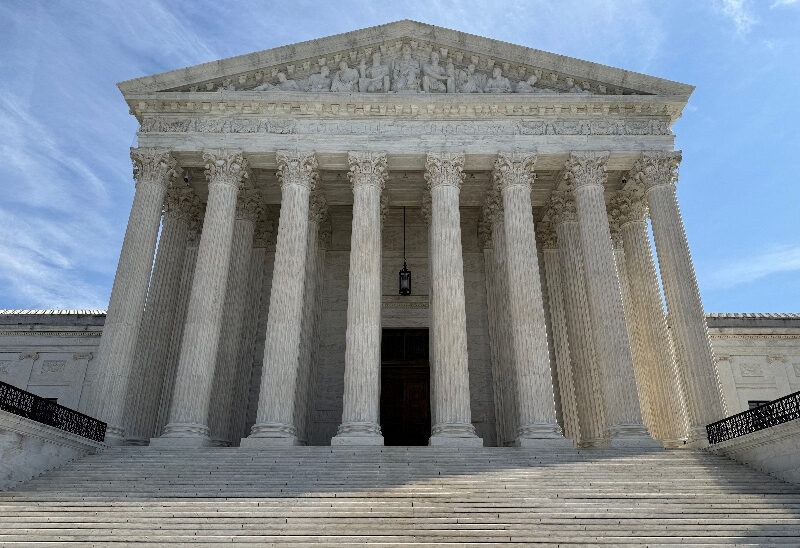
US Supreme Court rejects Massachusetts school gender-identity policy challenge
Reuters//April 20, 2026//


 Listen to this article
Summary:
- U.S. Supreme Court declined parents’ appeal on gender identity policy
- 1st U.S. Circuit Court of Appeals upheld dismissal of parental rights claim
- Parents represented by Alliance Defending Freedom legal group
The U.S. Supreme Court declined on April 20 to hear a bid by parents to sue a public school district in Massachusetts over actions by teachers and officials to support the gender identity of students by not disclosing name or pronoun changes to parents without the child’s consent.
The justices turned away an appeal by the parents of a student who had self-identified as “genderqueer” while attending a middle school in the Massachusetts town of Ludlow after a lower court threw out their lawsuit.
The plaintiffs claimed officials treated their child as nonbinary and hid this information from them in violation of their fundamental parental rights as protected by the U.S. Constitution’s 14th Amendment promise of due process.
The case comes in the wake of a significant decision by the court on March 2 to block similar measures in California that could limit the sharing of information with parents about the gender identity of transgender public school students without the child’s permission.
Disputes over efforts to support and protect the privacy of transgender and gender non-conforming students are playing out across the United States. The court in 2024 turned away similar challenges in Wisconsin and Maryland.
The court, which has a 6-3 conservative majority, is also confronting escalating efforts by President Donald Trump’s administration and Republican-led states to restrict the rights of transgender people. In June 2025, the court upheld a Republican-backed ban in Tennessee on gender-affirming medical care for transgender minors. In January, the court also appeared ready to uphold state laws banning transgender athletes from female sports teams, with a ruling still pending on that matter.
The Massachusetts parents, Stephen Foote and Marissa Silvestri, said in court papers that teachers and officials at Baird Middle School in Ludlow pushed “gender ideology” on children without the knowledge of parents. As a result, the plaintiffs said, their 11-year-old child, known as “B.F.,” began to question the student’s gender identity.
After asking teachers and staff to use a new name and pronoun, the student also asked school officials to continue to use the child’s original name and female pronouns when communicating with the parents, according to court filings.
The child identified as genderqueer, meaning a person who does not follow binary gender male-female norms.
The parents sued the town, the Ludlow School Committee and certain officials, saying their actions undermined their 14th Amendment due process rights, which the Supreme Court has long held protects the fundamental right of parents to direct the care and upbringing of their children.
The parents said that “so-called gender transition” is harmful and that theirs is a moral objection, not a religious one. They are being represented at the Supreme Court by the Alliance Defending Freedom conservative Christian legal group.
A federal judge threw out the case in 2022. The Boston-based 1st U.S. Circuit Court of Appeals upheld the dismissal in 2025, concluding that the parents had not sufficiently shown a deprivation of their parental rights, including to direct the medical care of their child.
The 1st Circuit said it was “unconvinced that merely alleging Ludlow’s use of gender-affirming pronouns or a gender-affirming name suffices to state a claim that the school provided medical treatment to the student.”
The deference by school officials to the wishes of students about whether to disclose their gender identity to parents allows the children to “express their identity without worrying about parental backlash,” the 1st Circuit said, adding that the protocol does not coerce students to conceal information or restrain the actions of parents outside of school.
“Parents remain free to strive to mold their child according to the parents’ own beliefs,” the 1st Circuit said.
(Reporting by Andrew Chung in New York; Editing by Will Dunham)
Related Articles
Related Content





Business Law
- Economy forces attorneys to get down to business
- Business Court judges trawl for customers
- Va. company's Web site did not subject business to personal jurisdiction in S.C., appeals panel rules
- Former running back from S.C. wins courtroom victory in contract dispute
- Contract – Government Contract – Qui Tam – False Claims Act
- Licenses & Permits – Beer & Wine Permit – Restrictive Covenant – Suitable Location
- Consumer Protection – FCRA – Auto Loan – Bank Accounting Errors
- Licenses & Permits – Veterinarian – Vaccine Maintenance
- Tort – Business Tort – Va. Computer Crimes Act – Trade Secrets
- Textile firm, railroad settle Graniteville train wreck lawsuit
- State regulators look at car dealer accused of lying to customers
- Subprime mortgage meltdown hits securities law


Commentary
- ‘AI won’t take your job’ and other things CEOs say before the layoffs
- When not to believe (your lyin’ eyes)
- Conduct a technology audit to improve law firm efficiency
- When the client brings ChatGPT to the consultation
- Where is she now, this model who was so beautiful?
- Content Marketing: Where law firms lose referrals and how to prevent it
- Your best people are not leaving for more money — they are leaving because you stopped paying attention
- Best at Work Insights: The choice we’re making about AI
- Beyond burnout: The case for workplaces where people thrive
- The December question every leader should anticipate
- Best at Work Insights: Don’t Import 996: Why America Should Reject Overwork Culture
- Law ‘n History: The beer, scandal and haunted mansion of the Lemp dynasty
Polls
 Loading ...


SC Lawyers Weekly keeps you connected with the latest legal news, Daily Practice and Breaking
News alerts.
Sign-up for SC Lawyers Weekly Email Alerts
