Please ensure Javascript is enabled for purposes of website accessibility

Visa, Mastercard $38 billion swipe fee settlement wins US judge’s approval

Summary: U.S. District Judge Brian Cogan grants preliminary approval Settlement covers more than 12 million merchants Nobel economist Joseph Stiglitz supports settlement benefits     A U.S. judge granted preliminary approval to Visa's and Mastercard's revised $38 billion settlement with merchants who accused the card networks of charging too much to process payments on their credit cards. U.S. District Judge Brian Cogan in Brooklyn, New York, said the settlement covering more than 12 million merchants was "fair, reasonable, and adequate," and that he was likely to eventually grant final approval. Cogan ruled on Tuesday, nearly two years after a different judge rejected a proposed $30 billion settlement as too small. Some groups including the National Retail Federation, the world's largest retail trade group, also opposed the new settlement and plan further challenges. The settlement announced in November was intended to end litigation that began in 2005, when merchants accused Visa, Mastercard and banks of conspiring to violate U.S. antitrust laws, including through the collection of "swipe fees." SWIPE FEES WOULD BE CUT Also known as interchange fees, swipe fees totaled $118.8 billion for Visa and Mastercard in the United States in 2025, up from $111.2 billion in 2024 and $25.6 billion in 2009, the Merchants Payments Coalition said. The average fee was 2.36 percent. Visa and Mastercard agreed to lower swipe fees by 0.1 percentage point for five years, while standard consumer rates would be lowered to no more than 1.25 percent for eight years. Merchants could also choose whether to accept cards in distinct categories: commercial cards, premium consumer cards — including the popular rewards cards that dominate the card market — and standard consumer cards. That provision would effectively end the longstanding "Honor All Cards" rule requiring merchants to accept all Visa and Mastercard cards or none. Merchants also got more options to impose surcharges on customers. Visa shares rose 1.7 percent on Tuesday while Mastercard shares rose 2 percent. MORE OBJECTIONS PREDICTED In separate statements, the National Retail Federation and the National Association of Convenience Stores said the revised settlement failed to address a "broken" credit card market, and NACS General Counsel Doug Kantor predicted "many more objections" will be filed. Objectors said merchants would still pay too much to accept rewards cards and be required to "honor all issuers" in a given network, meaning they could not accept one bank's cards and reject another's. Cogan said many objections had merit, but the settlement didn't need to be perfect. "The objectors identify several things that they want to do but can’t (e.g., rejecting cards at the issuer-level, surcharging at the issuer-level) and that they theoretically can do but won’t (e.g., rejecting premium cards)," he said. "But the question is not whether the amended settlement constitutes the best possible recovery, end stop — it’s whether the amended settlement constitutes the best possible recovery in light of what can be gained and lost through trial." Other objectors included Walmart and the Merchants Payments Coalition. Neither immediately commented. NOBEL ECONOMIST SAYS CONSUMERS COULD BENEFIT The card networks welcomed Cogan's decision. Visa said the settlement gives merchants more flexibility in accepting payments, while Mastercard said the accord "balances the interests of all parties." Supporters of the settlement included the Electronic Payments Coalition, whose members include the card networks and large issuers such as Bank of America, Capital One, Chase and Citibank. Two experts hired by the plaintiffs, Nobel Prize-winning economist Joseph Stiglitz and University of Washington professor Keith Leffler, said the changes could save merchants $38 billion by 2031 and provide $224 billion of benefits overall, including to consumers. The $30 billion settlement would have lowered swipe fees by 0.07 percentage point over five years and also allowed more surcharges. In rejecting that accord in June 2024, U.S. District Judge Margo Brodie said fees would have still been above where they were absent any antitrust violations, and merchants would remain stuck with the "Honor All Cards" rule. Reporting by Jonathan Stempel in New York. Editing by Aurora Ellis, Bill Berkrot and Mark Potter

Teachers association takes on Trump in RI court over money for English learners

Summary: National Education Association files suit in Rhode Island federal court ExcEL Educators Leadership Academy lost $6 million in grant funding U.S. Department of Education cited for alleged First Amendment violations     The national teachers’ union is suing the U.S. Department of Education, challenging what it describes as the illegal termination of hundreds of millions of dollars in federal grants aimed at improving instruction for thousands of English language learners.  The Lawyers’ Committee of Rhode Island, the Southern Poverty Law Center and the National Education Association, on behalf of its 3 million members, filed suit in U.S. District Court in Rhode Island seeking a court order blocking the termination of the grants.  According to the complaint, the U.S. Department of Education in 2025 halted funding for national professional development grants for programs to support the training and certification of bilingual teachers for English language learners, one of the fastest growing segments of students in the country. The discontinuation notices, including those to a Pawtucket nonprofit, came with little or no warning and were driven by concerns about diversity, equity and inclusion initiatives.  “The Trump administration terminated these grants to punish Americans for saying things it doesn't want to hear. The combed through grant applications hunting for words it deemed ‘divisive ideology,’ like diversity and equity, and then defunded the programs that used them. That is a textbook First Amendment violation, and it has dismantled teacher-certification pipelines in a dozen states and stripped English learner students of the qualified educators the law guarantees them,” Amy Romero, chief legal counsel of Lawyers’ Committee for Rhode Island, said in a news release.  The lawsuit alleges violations of the plaintiffs’ First Amendment rights to freedom of expression and viewpoint discrimination, as well as violations of the Administrative Procedures Act, which governs decision making for federal agencies.  Pawtucket nonprofit program `dismantled’  The lawsuit was brought on behalf of the NEA and its members; and Laureen Avery, administrator for ExcEL Educators Leadership Academy, a nonprofit organization based in Pawtucket. ExcEL received about $6 million in multi-year grants that were discontinued. The National Professional Development program was created by Congress as part of the No Child Left Behind Act to award competitive grants to address the shortage of bilingual and English as a Second Language teachers.  “For the educators participating in ExcEL, this grant represents far more than a funding stream — it is a pathway to earning the qualifications needed to effectively serve multilingual learners,” Avery, a founder of ExcEL, said in a statement. “The department’s decision disrupts ongoing professional learning and networks, undermines educator preparation efforts, and jeopardizes services that directly benefit students and families.” As a result of the cuts, Avery lost her job, and the coaching network for ESL teachers was dismantled, the lawsuit says. Tina Cheuk, a professor in California whose research for Project BRILLANTE focuses on Science, Technology, Engineering and Math literacy for English language learners, is also a plaintiff. That program received $3.3 million in grants that have been cut off.  The Department of Education and U.S. Education Secretary Linda McMahon are named defendants. The government has not yet responded in court.  Was `coded language' targeted?  The lawsuit alleges that the federal government ignored its own performance-based regulations and previously established legal criteria for evaluating grant recipients.  They argue that federal education officials instead of relying on data justified terminating the funding by selectively searching for “coded language” associated with DEI in grant applications that had previously been approved.  The Education Department announced it would terminate more than $600 million in grants for what it characterized as “divisive ideologies.”  The loss of grants has led to districts losing their pipeline to ESL teachers, students lost equal education opportunities to work with credentialed educators and teachers lost access to professional training, the lawsuit says.  Reporting by Katie Mulvaney, Providence Journal / The Providence Journal USA TODAY Network via Reuters Connect

US judge asked to bar Trump’s UFC fight at White House

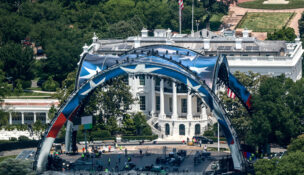
Summary: Plaintiffs seek temporary restraining order from Judge Amit Mehta Lawsuit challenges National Park Service and Interior Department approval Event scheduled for trump’s 80th birthday on june 14 A federal judge in Washington has been asked to block President Donald Trump’s plan to host an Ultimate Fighting Championship mixed martial arts bout at the White House next week and to halt construction of the metal arena structure ​called "the Claw" on the South Lawn of the iconic executive residence.  Two Washington-area residents in a June 7 court filing asked U.S. District Judge Amit Mehta to issue a temporary restraining order halting the event, scheduled to coincide with Trump’s 80th birthday on June 14.  On June 8, Mehta asked the lawyers in the case to propose a schedule to hear the emergency request.  Dubbed “UFC Freedom 250", the event is set to feature fighting inside the 92-foot-tall (28 meters), octagon-shaped cage with weigh-ins at the nearby Lincoln Memorial.  The lawsuit, filed on June 6, alleges that authorization of the program by the National Park Service and Interior Department was unlawful and should be set aside. “This nation’s public monuments should not be loaned out for private exploitation,” the plaintiffs said. In a statement, the White House called the case an “obstructionist, baseless, and dilatory lawsuit” and said the event “is no different than the various other White House-hosted events on the South Lawn and properly permitted events on the Ellipse and National Mall throughout the year.” The lawsuit contends the event violates rules barring sporting events on the South Lawn and at the Lincoln Memorial, and that construction of the large arena structure requires congressional authorization. Trump is facing other lawsuits over construction projects on the White House and elsewhere in the capital, including his plan to build a 90,000-square-foot ballroom on the site of the demolished East Wing, and his proposal to renovate and close the John F. Kennedy Center for the Performing Arts.  Reporting by Mike Scarcella; Editing by David Bario and Bill Berkrot